CEO Roundtable
The CEO Roundtable is an exclusive event bringing together top business leaders to discuss strategic approaches to sustainability and responsible business practices.

Co-funded by Enterprise Singapore, this programme pairs two days of training with one-to-one advisory to move social sustainability from compliance to action, in line with the direction of the emerging TISFD framework.
Why this matters:
Social sustainability is no longer a side issue. More than 900 experts surveyed by the World Economic Forum rank societal polarisation among the five greatest risks facing the world today, and people risks are increasingly material to business and financial performance. Businesses have a critical role to play, but real progress means moving beyond compliance to become part of the solution.
Programme description:
Designed for organisations with established ESG foundations that are ready to deepen their social impact, this subsidised programme combines taught and advisory support. Participants learn to identify impacts on people, assess human capital dependencies, strengthen social impact governance, and address risks and opportunities, within their own organisation and across the value chain, with greater depth and rigour than a standard ESG workshop.
| Item | Detail |
|---|---|
| Programme | People in the Value Chain: From Compliance to Deeper Impact |
| Funding partner | Enterprise Singapore (subsidy on package fees) |
| Inaugural intake | 11-12 November 2026 |
| Format | Two-day taught programme, plus one-to-one advisory delivered within six months of the workshop |
| Target functions | Board & Management, HR, Procurement & Supply Chain, Sustainability, Compliance & Risk, Marketing & Communications |
| Target companies | Mid- to large-sized companies in Singapore integrating social sustainability into their ESG strategy, at varying stages of maturity |
| Certification | Certificate of completion, issued by UN Global Compact Network Singapore |
The programme runs in two phases.
Phase 1 is a two-day training built around fundamental knowledge, interactive workshops, case studies and structured reflection. Participants learn to identify social impacts, dependencies and inequality drivers — across their own organisation and their value chain.
Phase 2 is one-to-one advisory: depending on where the organisation is on its sustainability journey, a consultancy engagement (Package A or B, see 2.8) follows within 6 months of the workshop.
Suggestion: present this as an accordion / expandable list so the page stays easy to scan. Each module shows: title, goal, and 3–4 key points.
Goal: establish a shared foundation for the full programme.
Goal: understand and improve how the organisation treats its direct employees.
Goal: identify and address labour and human rights risks in global supply chains.
Goal: understand how products and services create or mitigate social risks for customers.
Goal: develop a strategic approach to the organisation’s broader societal footprint.
Following the training, participants move into one-to-one advisory. Which package is the right fit depends on where the organisation stands today:
| Level | Company profile | Recommended package |
|---|---|---|
| Level 0 — Foundation | Limited or informal social sustainability practices; no formalised policies |
Package A For companies early in their social sustainability journey, building structure and understanding. Closes operational ESG gaps and establishes the foundational policies, processes and reporting building blocks needed to manage social risk.
|
| Level 1 — Implementation | Some formalised initiatives in place; gaps remain in policy coverage, measurement and accountability |
Package A For companies early in their social sustainability journey, building structure and understanding. Closes operational ESG gaps and establishes the foundational policies, processes and reporting building blocks needed to manage social risk.
|
| Level 2 — Advanced / Strategic | Established social sustainability practices; ready to go beyond operational ESG and align with TISFD |
Package B For companies with established practices, ready to move beyond operational ESG and align with TISFD recommendations.
|
Answer four short questions and we'll match you to Package A or Package B, with indicative pricing and the Enterprise Singapore subsidy applied.
Under Enterprise Singapore's definition, an SME has group annual sales turnover of up to S$100 million, or fewer than 200 employees.
Across your own workforce, suppliers, customers and community.
TISFD: the emerging Task Force on Inequality and Social-related Financial Disclosures.
Your answers suggest you're early in formalising social sustainability. Package A is built to close operational ESG gaps and put the core building blocks in place.
Package A: S$4,800 per SME company, S$1,440 after a 70% Enterprise Singapore subsidy.
Package B: S$8,000 per non-SME company, S$4,000 after a 50% Enterprise Singapore subsidy.
| Package A | Package B | |
|---|---|---|
| For | Level 0–1 — SME, building structure | Level 2 — non-SME, aligning with TISFD |
| Price (before subsidy) | S$4,800 per company | S$8,000 per company |
| Enterprise Singapore subsidy | 70% | 50% |
| Price after subsidy | S$1,440 per company | S$4,000 per company |
| Scope | 2 days, up to 2 participants, 4 hours advisory | 2 days, up to 2 participants, 7 hours advisory |
| Additional participant | S$1,600 per additional participant | S$1,600 per additional participant |
A Certificate of completion, issued by UN Global Compact Network Singapore (UNGCNS).






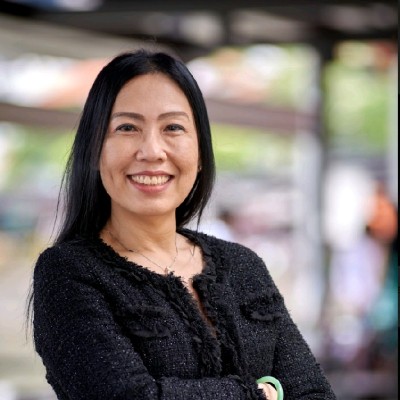
Director, Capability Building & Social Impact
UN Global Compact Network Singapore (UNGCNS)

Sue Meng has 20 years of experience in strategy, sustainable development and strategic communications. At UNGCNS, her work spans training, partnership development, thought leadership publications and events. She is an adjunct lecturer on stakeholder engagement and social impact at the School of Business, Singapore University of Social Sciences.

Founder and Managing Director of Sustainao
A Singapore-based sustainability consulting firm
Ivona helps organisations move beyond compliance and create long-term value through training, strategy development, implementation support, reporting and ESG ratings advisory. She previously worked as a sustainability auditor at KPMG France.
 Looking ahead: the Social Sustainability Award
Package A is for organisations at any of the following junctures of their social sustainability journey: limited or informal practices; no formalised policies, or some formalised initiatives in place; where gaps remain in policy coverage, measurement and accountability. Package A comes with 4 hours of advisory after the 2-day workshop. Depending on where the business is early in their social impact journey, this package helps with the foundational policies, processes and reporting building blocks needed to manage social risk and meet growing stakeholder expectations. This could range from a social materiality assessment · Gap analysis · 12-month roadmap · one workplace policy · Supplier Code of Conduct (SCOC) or Sustainable Procurement policy.
Package B helps to take your social impact actions to a more Advanced, Strategic level. It is suitable for companies with established social sustainability practices ready to move beyond current social sustainability policies and practices. Package B comes with 7 hours of advisory after the 2-day workshop. Package B prepares companies to align with the emerging TISFD disclosure framework — helping create awareness, refine existing social sustainability topics and address their activities that affect people and consequently also lead to the business’ financial, and system-level risks.
Each company can send two participants to the programme. Because social impact actions cut across all functions of an organisation, the programme is ideal for officers from Human Resources, Procurement, Sustainability, Compliance and Risk, and Marketing and Communications and CSR.
Advisory has to be completed within 6 months of the workshop.
People in the Value Chain: From Compliance to Deeper Impact is suitable for businesses that have an established ESG programme.
If you are an SME at a less mature phase of your social impact journey, Enterprise Singapore will subsidise 70% of the cost of Package A which is $4800. Your final cost after 70% subsidy is $1440.
If you are a non-SME, Enterprise Singapore will subsidise 50% of the cost of Package B which is $8000. Your final cost after 50% subsidy is $4000.
The UN Global Compact Network Singapore will issue participants a Certificate of Completion upon successful completion of the full programme
Businesses and financial institutions may send more than 2 participants to the programme. Each additional participant costs $1600. If you are an SME, Enterprise Singapore will subsidise 70% of this cost for up to 2 additional participants. Non-SMEs receive 50% subsidy.
SMEs on Package A can choose to level up their social impact to match that of a non-SME with additional 3 hours advisory to Package B deliverables. The cost for the top up is $2400, with 70% subsidy.
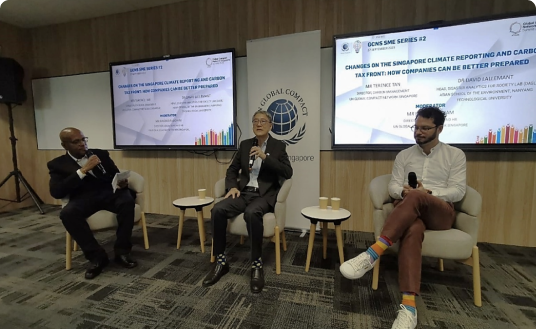
The CEO Roundtable is an exclusive event bringing together top business leaders to discuss strategic approaches to sustainability and responsible business practices.

The RICE tool helps companies assess and manage their resilience, impact, compliance, and engagement in sustainability, enabling a strategic approach to responsible business practices aligned with global standards.
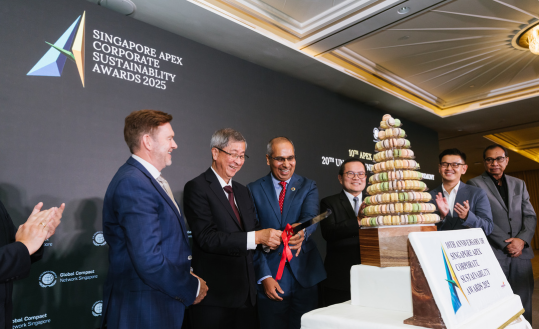
The Singapore Apex Sustainability Awards recognize outstanding businesses and organizations that have demonstrated exceptional leadership and commitment to sustainability.

