Foundations in Corporate Sustainability
This course provides essential knowledge and tools for understanding and implementing sustainable business practices that align with global standards and drive long-term impact.
Businesses have a critical role to play in addressing complex social challenges — but rising beyond compliance requires more than good intentions. It requires a common model, a shared language, and consistent metrics to understand and disclose the negative and positive impacts of business on people, as well as the dependencies on society that in turn create risks and opportunities for the business itself.
This half-day course addresses that need directly. It establishes a shared foundation for practitioners who want to move beyond compliance and engage with social issues as a source of business value, resilience, and long-term competitive advantage. Drawing on current data, real-world examples, and the emerging TISFD disclosure standard, participants explore why inequality is a material business risk, what a credible social strategy looks like, and how to begin structuring social disclosures in line with international best practice.

Persistent inequalities are eroding people’s wellbeing, limiting opportunity, and threatening the social stability that businesses and economies depend on. More than 900 experts interviewed by the World Economic Forum rank societal polarisation as one of five greatest risks faced today, and people risks are material business and financial risks. Yet social sustainability, and the processes and mechanisms that lead to their destabilisation, remain underexplored, underdefined, misunderstood and even feared.
Awareness alone is rarely sufficient to translate insight into effective action. Real, lasting impact happens when organisations shift their attitudes, habits, and choices in ways that benefit society. Businesses have a critical role to play in addressing complex social challenges — but rising beyond compliance requires more than good intentions. It requires a common model, a shared language, and consistent metrics to understand and disclose the negative and positive impacts of business on people, as well as the dependencies on society that in turn create risks and opportunities for the business itself.
This half-day course addresses that need directly. It establishes a shared foundation for practitioners who want to move beyond compliance and engage with social issues as a source of business value, resilience, and long-term competitive advantage. Drawing on current data, real-world examples, and the emerging TISFD disclosure standard, participants explore why inequality is a material business risk, what a credible social strategy looks like, and how to begin structuring social disclosures in line with international best practice.
Coming soon
Coming soon
Singapore Sustainability Academy, 180 Kitchener Rd, #06-10, Singapore 208539
Coming soon
Non Member: $1000 SGD
Member : Enjoy additional 21% discount. Avail the offer at $790 SGD
The programme draws on current data, real-world examples, and the emerging TISFD disclosure standard, participants explore why inequality is a material business risk, what a credible social strategy looks like, and how to begin structuring social disclosures in line with international best practices.
At the end, participants will be able to:
This modular three part programme is delivered through lectures, discussions, exercises and presentations.
Global inequality is rising, yet most companies’ social efforts – whether in reporting, strategy, or day-to-day decision-making – remain narrow, fragmented, and disconnected from the broader sustainability agenda. This module confronts that gap head-on: why the ‘S’ is the standardised pillar of ESG, how social considerations are routinely siloed or reduced to a handful of HR metrics, and why inequality – already ranked among the top five global risks by the WEF – represents a material financial exposure that businesses can no longer defer.
Addressing social issues is no longer just a matter of doing less harm – it is increasingly a driver of how leading companies compete, innovate, and build resilience. This module examines how businesses are redesigning their models to create value for both society and shareholders, moving from a logic of mitigation and philanthropy towards one of strategic differentiation. Through real-world examples, participants explore what it looks like when social impact is embedded at the core of a business – and what it takes to get there.
Established in 2024 by a global coalition of businesses, investors, civil society, and labour organisations, TISFD is the emerging global standard for social and inequality-related financial disclosures. This module builds a working understanding of its core principles – how companies affect people, what they rely on from society, and how social conditions translate into financial risk and opportunity – through the Impacts-Dependencies-Risks-Opportunities (IDRO) model. Through a hands-on simulation using realistic business scenarios, participants engage with these principles in practice and develop the fluency needed to apply them.
Upon completion of the course, participants will be awarded a certificate of completion by United Nations Global Compact Network Singapore
Registrations will only be confirmed upon successful completion of payment


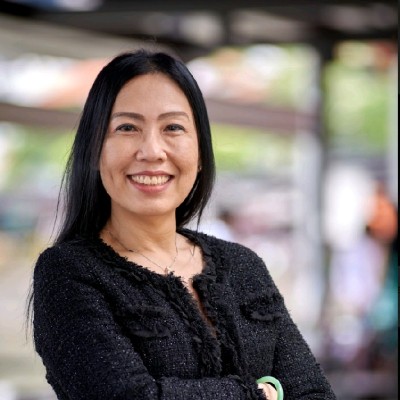
Director, Capability Building & Social Impact
UN Global Compact Network Singapore (UNGCNS)

Sue Meng has 20 years of experience in strategy, sustainable development and strategic communications. At UNGCNS, her work spans training, partnership development, thought leadership publications and events. She is an adjunct lecturer on stakeholder engagement and social impact at the School of Business, Singapore University of Social Sciences.

Founder and Managing Director of Sustainao
A Singapore-based sustainability consulting firm
Ivona helps organisations move beyond compliance and create long-term value through training, strategy development, implementation support, reporting and ESG ratings advisory. She previously worked as a sustainability auditor at KPMG France.

This course provides essential knowledge and tools for understanding and implementing sustainable business practices that align with global standards and drive long-term impact.

The RICE tool helps companies assess and manage their resilience, impact, compliance, and engagement in sustainability, enabling a strategic approach to responsible business practices aligned with global standards.

This programme combines the expertise of UN GCNS and Nanyang Technological University to equip leaders with the knowledge and tools for advancing corporate purpose and sustainable finance.

